Where Can a Counseling Degree Take You?
Demand for counselors is rising across nearly every setting where people need support. The U.S. Bureau of Labor Statistics projects employment of mental health counselors to grow 17% between 2024 and 2034, far faster than the average occupation, with roughly 48,300 openings expected each year. Schools, hospitals, colleges, and community agencies are all looking for qualified people to fill those roles.
Veronica Lampe, Ph.D., has spent her career on both sides of that demand. She worked as a school counselor for 13 years, has been in the field since 2008, and is now an assistant professor of counseling and program director at Lakeland University.
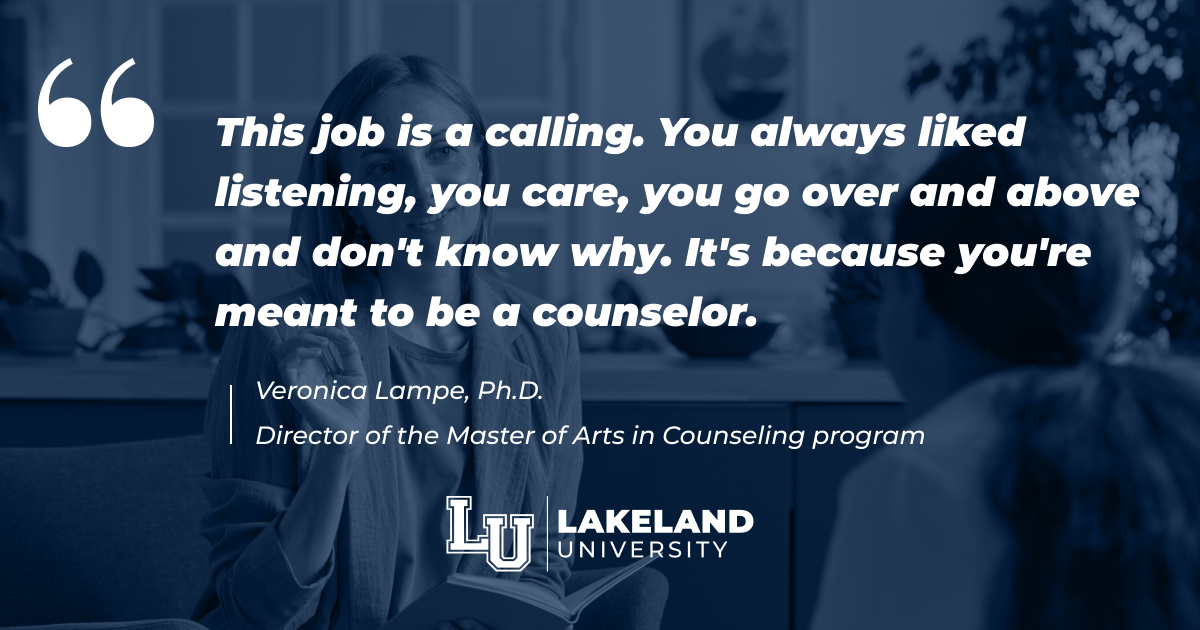
"This job is a calling," Lampe says. "You always liked listening, you care, you go over and above for other people, and you don't even know why. It's because you're meant to be a counselor."
She puts it another way for students who are still deciding. “When people keep coming to you because they know you are a good listener. You choose compassion over judgment and understanding over assumptions. That's what counselors do."
School counselors support students academically, socially, and emotionally, often serving as the first point of contact when a student or family needs help. The role involves working directly with students, collaborating with teachers, and connecting families to outside resources when needed. The school counseling concentrations built to lead toward state licensure, since that credential is what actually gets you into a school district.
Clinical mental health counselors work in community agencies, inpatient facilities, and private practice, supporting individuals and families through a wide range of concerns. This is also where much of the field's job growth is concentrated, as more people seek support for anxiety, depression, and other mental health needs.
A counseling degree also opens doors in higher education, including roles in student affairs, academic advising, and college counseling centers. These positions focus on student success and retention, and they can take different shapes depending on the school, from career services to residence life.
Most people who finish a counseling degree don't scatter across dozens of unrelated jobs. They tend to land in one of three places: schools, mental health settings, or higher education.
"Almost everyone who finishes ends up as a school counselor, a mental health therapist, or working at a college or university," Lampe says. That focus is part of what makes the degree practical. Rather than spreading coursework thin across every possible counseling-adjacent topic, Lakeland University is organized around a small number of clear concentrations, so students can choose a direction early and build real depth in it.
A counseling degree blends classroom theory with direct client experience, and the practicum and internship requirements are where that experience becomes real.
State-approved programs require a practicum of roughly 125 hours of supervised counseling work, including at least 50 hours of direct client contact involving assessment, evaluation, and intervention. The internship that follows requires a 300-hour minimum placement, with at least 40% of that time spent working directly with clients under supervision.
In many programs, students are assigned a placement site rather than choosing their own. "We let students pick their own placement," Lampe says. "They choose the fit they think is best for them." Some students complete their practicum and/or internship at a workplace they're already part of, which can make the transition into the field even smoother.
Faculty who are currently working in the counseling field tend to bring something academics alone can't. " Our faculty are current mental health practitioners,” Lampe says of her colleagues, many of whom bring anonymous case material from that same week into the classroom.
A psychology background isn't required to start a counseling degree. Lakeland University asks for nine (9) undergraduate semester hours in courses related to human services or behavioral science with grades of at least BC. That makes the degree realistic for people coming from finance, biology, education, or almost anywhere else.
"It's never too late to do a career switch," Lampe says.
A Master of Arts in Counseling can lead to a career in a school hallway, a community clinic, or a college campus.
If you're exploring programs, look closely at licensure pathways, practicum and internship requirements, and how much input you'll have in choosing your own placement. Those details will shape your experience more than the brand name on the diploma.
Explore the Master of Arts in Counseling program at Lakeland University.