Blog
What to Look for in an Exercise Science Program
Oct. 14, 2026
Not every exercise science program prepares you the same way.
Some keep you in lecture halls and textbook labs for most of your degree. Others put you in real testing environments from your first year, working with real athletes, real data, and real equipment. That difference shapes how ready you are for grad school, a clinical role, or a job in sports performance the day you graduate.
Caleb Voskuil, Ph.D., assistant professor of exercise science at Lakeland University, has experienced both ends of that range. He completed his graduate work at the University of Kentucky and Texas Christian University, where his dissertation tracked body composition and Achilles tendon health across a full year with TCU's football team.
That kind of applied, athlete focused research now shapes how he teaches his own students.
"I like to call our exercise science department a little diamond in the middle of a cornfield," Voskuil says.
Dr. Voskuil helped identify some things to look for in a modern exercise science degree.
What to Look for in an Exercise Science Program
Hands-On Learning Opportunities
There’s a lot you can do with a bachelor’s degree in exercise science, from continuing your studies to entering the workforce to coach or train athletes.
The strongest exercise science programs get you into internships, co-ops, or clinical placements early, instead of waiting until senior year.
At Lakeland, students can earn up to 25% of their degree through paid co-op work experience, and roughly 20 to 25% of exercise science majors are doing hands-on research or testing work alongside faculty.
"Students in an exercise science program don't have to run the same race," Voskuil says. "You can come in and get that hands-on experience. You're here to get a degree and skills, connection and hands-on work."
Research Opportunities
Undergraduate research access can be limited in this field, which is exactly why it matters when a program does offer it.
Programs that send students to present at conferences, and occasionally co-author peer reviewed publications, give you something most undergraduates never get: a real research record before you even apply to grad school.
Lakeland students have produced 77 presentations at state, national, and international conferences. Last year, 15 of the program's 57 majors worked directly on research projects with Voskuil, testing athletes and analyzing the results themselves.
Facilities and Equipment
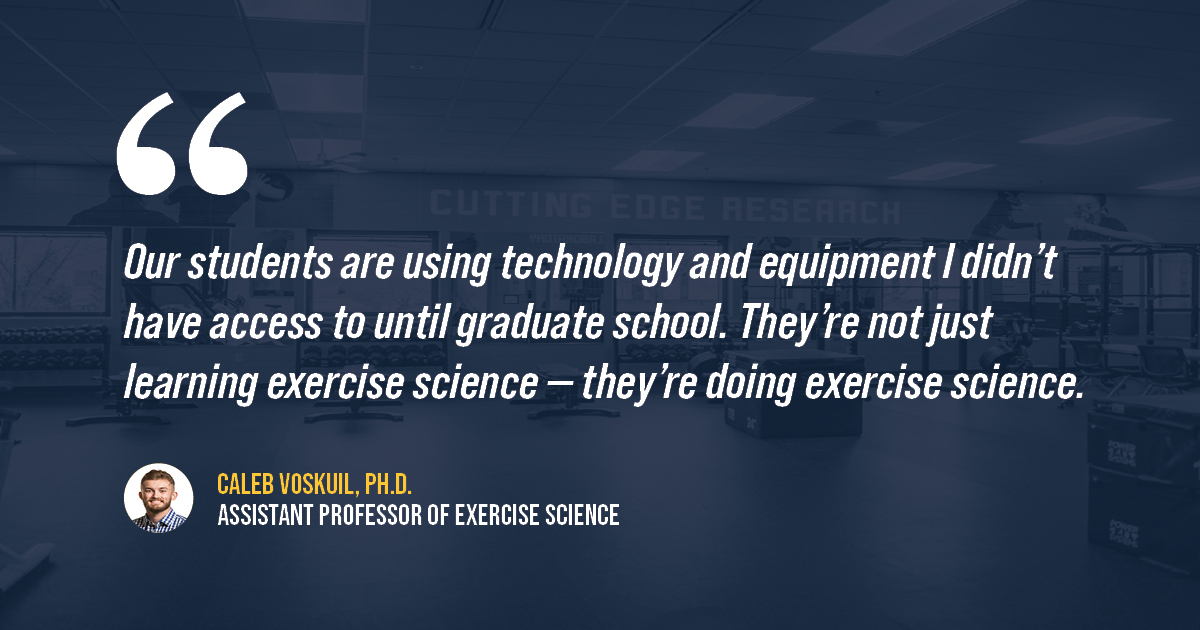
Lab quality shapes the depth of your learning. At Lakeland, students work with equipment used in real-world exercise science and human performance settings, including force platforms, EMG systems, metabolic analyzers, diagnostic ultrasound, body composition technology and GPS load monitoring. Dr. Caleb Voskuil notes that having this level of capability and access to equipment is rare amongst Division III schools.
The Feldmann Exercise & Sport Science Lab has also earned international recognition for its research. At the 38th Conference of the International Society of Biomechanics in Sports, Lakeland ranked second among U.S. institutions and eighth among approximately 225 universities worldwide for research presented and published at the conference.
That equipment and research experience translate into real findings, not just classroom demonstrations. When the softball team's performance dropped 20% between games during a tournament, GPS and intake tracking pointed to in-game nutrition as a contributing factor. Adjusting snacking between games led to a 10% performance increase the next day — a finding students helped uncover themselves.
Graduate and Professional School Placement
A program's placement record tells you more about your own future than almost anything else in a brochure.
Lakeland has maintained a 100% graduate and professional school acceptance rate over the past six years. Recent students have gone on to programs including a top-five physical therapy school at Northwestern, Central Michigan, Palmer School of Chiropractic, Bellin College for DPT, Concordia University Wisconsin for DPT, UW-Stevens Point for a Master’s in Athletic Training, and Marquette University for a Master’s in Athletic Training. .
"We're putting kids into the workforce," Voskuil says. "A hundred percent rate placing in grad schools."
Faculty Access and Mentorship
Smaller programs often mean more direct access to faculty, but that access only matters if it comes with real mentorship.
Lakeland's exercise science major is intentionally flexible. If you're headed toward medical school, you'll complete the hard sciences you need. If you're aiming for sports performance or strength and conditioning instead, you won't be stuck taking physics or chemistry you'll never use.
"What's the dream?" is the question Voskuil starts with for every student. The answer shapes their coursework, their research involvement, and their career planning from day one.
"Skills pay bills," he says.
Take the Next Step
Exercise science programs can look similar on paper: same core science requirements, similar course titles. The differences show up in the lab, in research access, and in where you end up after graduation.
Explore the Exercise Science program at Lakeland University.