Blog
LU class trip to Western U.S. an eye-opening experience
Jun. 3, 2026
This school year, Alyssa Voigt, a junior from New Holstein, Wis., majoring in marketing, is creating content for the Lakeland blog. She was named Lakeland’s Outstanding Student in Marketing this year. This is the latest in a series of blog stories she has written.
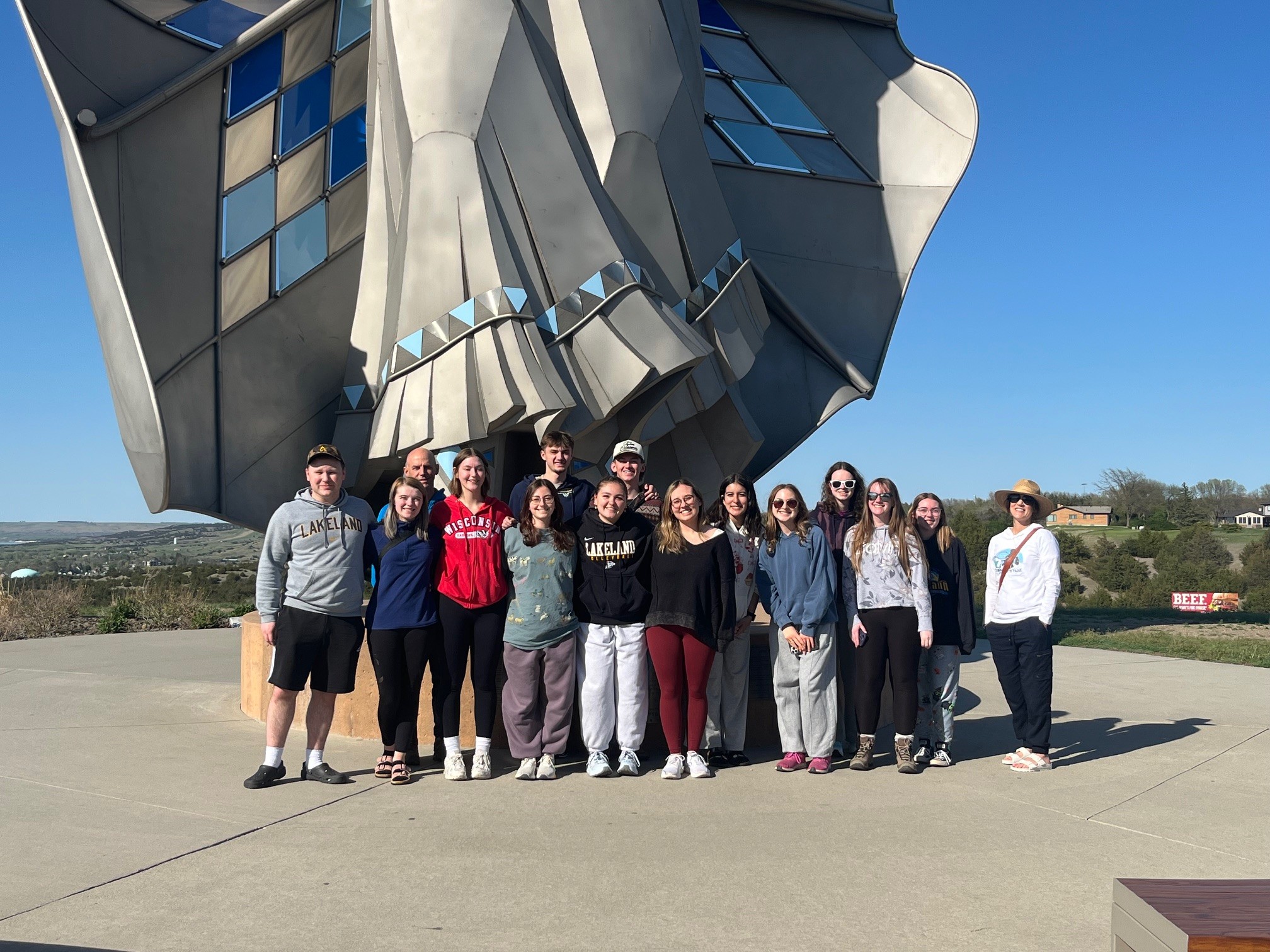
A group of 14 Lakeland University students and two faculty took the trip of a lifetime in May as part of a nine-day special travel study course focusing on public lands in western South Dakota and Northeastern Wyoming.
The honors and seminar II class visited numerous sites in the Badlands and the Black Hills and stayed in Custer State Park while exploring sites like Mount Rushmore, Crazy Horse Monument, Bear's Lodge or Devil's Tower and Wind Cave.
Students and the trip leaders also got up close and personal with wildlife, from bison to wild burros to pronghorn antelopes to bighorn sheep.
Lakeland Professor of Religion Karl Kuhn, Ph.D., and Associate Professor of Composition Alexis Piper, Ph.D., co-taught the course and led the trip.
This course explored the history, significance and future of America’s public lands. From city parks to vast wilderness areas, the students got to see America through an interdisciplinary lens, combining natural sciences, humanities and social sciences while engaging directly with these spaces through travel-focused experiential learning.
The courses met throughout the spring term and, during that time, visited local public lands around Lakeland as well as the Henschel Museum in Elkhart Lake, Wis.
For their final project, students were assigned to examine various issues related to the history, establishment, management, use and preservation of public lands in the United States. Students presented their chosen topic at a site of their choosing on the trip while teaching the rest of the class about the site and topic that they are passionate about.
Students visited numerous sites and participated in several activities, including:
- Wind Cave National Park: included guided hike and a van tour by staff from the Black Hills Parks and Forest Association, and a cave tour
- Coolidge Mountain Lookout
- Horseback riding at Blue Bell Stables
- Black Hills National Forest
- Black Elk Wilderness Area
- Crazy Horse Memorial: included guide tour of the museum, interaction with indigenous artists, and a bus tour to the base of the memorial
- Hike to the Black Elk Peak, the tallest peak in the Black Hills
- The Mammoth Excavation Site in Hot Springs
Students were able to choose to work individually or in a group. Students were also allowed to decide which venues they would present their chosen topics so the topics would best align with the setting logically and emotionally.
Topics presented by the students included:
- Native American Sacred Stories
- Stream Restoration on Public Lands
- The Decimation of the Bison Herd and its Restoration on Public Lands
- Gold Mining in the Black Hills
- Jurisdictional Issues related to Missing and Murdered Indigenous Women
- Lakota Claims to the Black Hills
- The History and Controversy of the Mt. Rushmore Memorial
- Hunting in National Parks and on Public Lands
The trip was funded through student contributions, fundraising efforts and direct gifts to support student travel.
Students' appreciation was evident through their excitement and joy when sharing their experiences.
Junior Samantha Klusman said her favorite parts were the bonds made along the way.
“This course had a way of bringing people together that I have never experienced before,” she said. “By the end, it felt like we were more of a family than just a group of people. Everywhere we went, there was always laughing and kind words shared. There was never a dull moment, and definitely not a negative one.”
Other students’ favorite parts focused more on historical importance. Senior Kaiden Dopp shared, “the places we visited because they all had historical importance to U.S. and Native American culture.”
The course’s instructors were equally grateful for this opportunity. Kuhn shared that one of his favorite parts of the cruise/trip was “witnessing the students’ sense of wonder at the beauty of the natural world, and their appreciation for the various experiences they encountered.”
Piper shared, “one of my most cherished parts of the trip, something that I will always remember, is seeing how students grew and developed as human beings throughout the course, especially on the trip. I saw some students I have known and worked with for years bloom into curious, competent, compassionate and confident best versions of themselves.
“I also really appreciated students profound and genuine passion for the material of the course, from the value of public lands to Indigenous environmental ethics to the positive affects of the natural world on human psychology. We all made social connections and friends for life.”
Klusman plans to take away how complicated public lands issues are and how important it is to see both sides of an argument.
“People have the tendency to believe the first thing they hear or what is said the most,” she said. “However, learning the positives and negatives of both sides can truly show why things can become so divided and the purpose behind that.”
Additionally, senior Emily Hansen shared her admirable appreciation and notable takeaways from the course and trip collectively.
“This trip was just amazing,” Hansen said. “I know this will be one of my fondest memories. Not only did I make new friends and have the most fun and laughter I’ve had in a while, but I learned so much and feel like my way of looking at the world has changed.
“I feel like I can understand and appreciate nature more than I ever have… Knowing the history of the places we visited helped me appreciate them more. This whole experience taught me so much and I am forever grateful and forever changed.”
Going forward, Kuhn hopes that students will take away an “increased understanding of the value and manifold benefits of public lands, the factors complicating their wise management, the threats to their ongoing existence and the importance of interacting with the natural world.”
Piper hopes that students will take away “how interconnected and vital public lands and the natural world are, and that we all have a responsibility to protect and stand up for public lands and other natural areas in our democracy.”