Blog
LU students dive into state environmental issues
May. 27, 2026
This school year, Alyssa Voigt, a sophomore from New Holstein, Wis., majoring in marketing, created content for the Lakeland blog. She was named Lakeland’s Outstanding Student in Marketing this year. This is the latest in a series of blog stories she has written.
Two Lakeland University classes participated this spring in Wisconsin Labs for Environment and Democracy (WiLEAD), a funded lab initiative aimed at building trust, reducing polarization, strengthening democratic principles and bridging the divide around key Wisconsin environmental issues.
The classes supported Lakeland’s experiential learning focus by creating opportunities for students to do a wide range of hands-on projects and relationship building with experts and community organizations.
The goal of the WiLEAD labs is to address everyday environmental issues and bring together students with community members and decision makers to combat polarization of environmental issues facing Wisconsin.
Lakeland was one of three Wisconsin schools hosting a lab during the 2025-26 academic year. Alexis Piper, Ph.D., associate professor of composition, and Jodie Mortag, MFA, associate professor of writing, led the labs in Lakeland’s “Misinformation and Disinformation” and “Environment and Consumption” courses.
Approximately 20 students representing a variety of majors took the courses and were divided into teams of 3-4. Mortag said the diversity of the students’ majors was a strength that allowed them to bring in their expertise when tackling sensitive environmental issues.
Lab progress was guided by the WiLEAD five-stage Lean Experiment Cycle. Each team received up to $1,000 for their proposed lean experiments, and students heard from guest speakers to explore environmental issues before finalizing experiments.
Students researched their environmental issues, connected with experts and community partners, created a comprehensive proposal including a work plan and budget and conducted regular meetings with community partners and Root Change representative Sue Bloom.
Students shared their findings and educated others on these topics during Lakeland’s Undergraduate Research Day on April 15 and during a joint summit at UW-Oshkosh on April 27 along with the other two schools who were part of the Civic Trust Labs to showcase learning to the other students and key Wisconsin stakeholders.
The student groups tackled a wide range of environmental issues:
- Piper’s first group worked on increasing the health of pollinators on campus, with a special focus on bats. Projects completed included installing bat houses and purchasing and planting pollinator-supportive seeds in campus no-mow zones. This group also executed partnerships with Maywood Environmental Park and two Lakeland facilities and ground employees, Nick Jensen and Dana Hanson, for expert guidance. Both Maywood and Lakeland received bat houses.
Jensen was impressed with the group’s work. “They did a good job informing students, faculty and staff about the plight of our native bats and tried hard to dispel misinformation about bats,” he said. “Unfortunately, it will take a while to know if the bat houses are being used and what kind of impact they will have on the bats on and around campus.”
- Piper’s second group focused on addressing food waste by engaging with Lakeland Dining Services and local restaurants.
- Piper’s third group tackled deer overpopulation on campus, working closely with Karl Kuhn, Ph.D., a Lakeland faculty member with DNR ties and additional DNR contacts, to explore solutions and the wider ecological impact of deer.
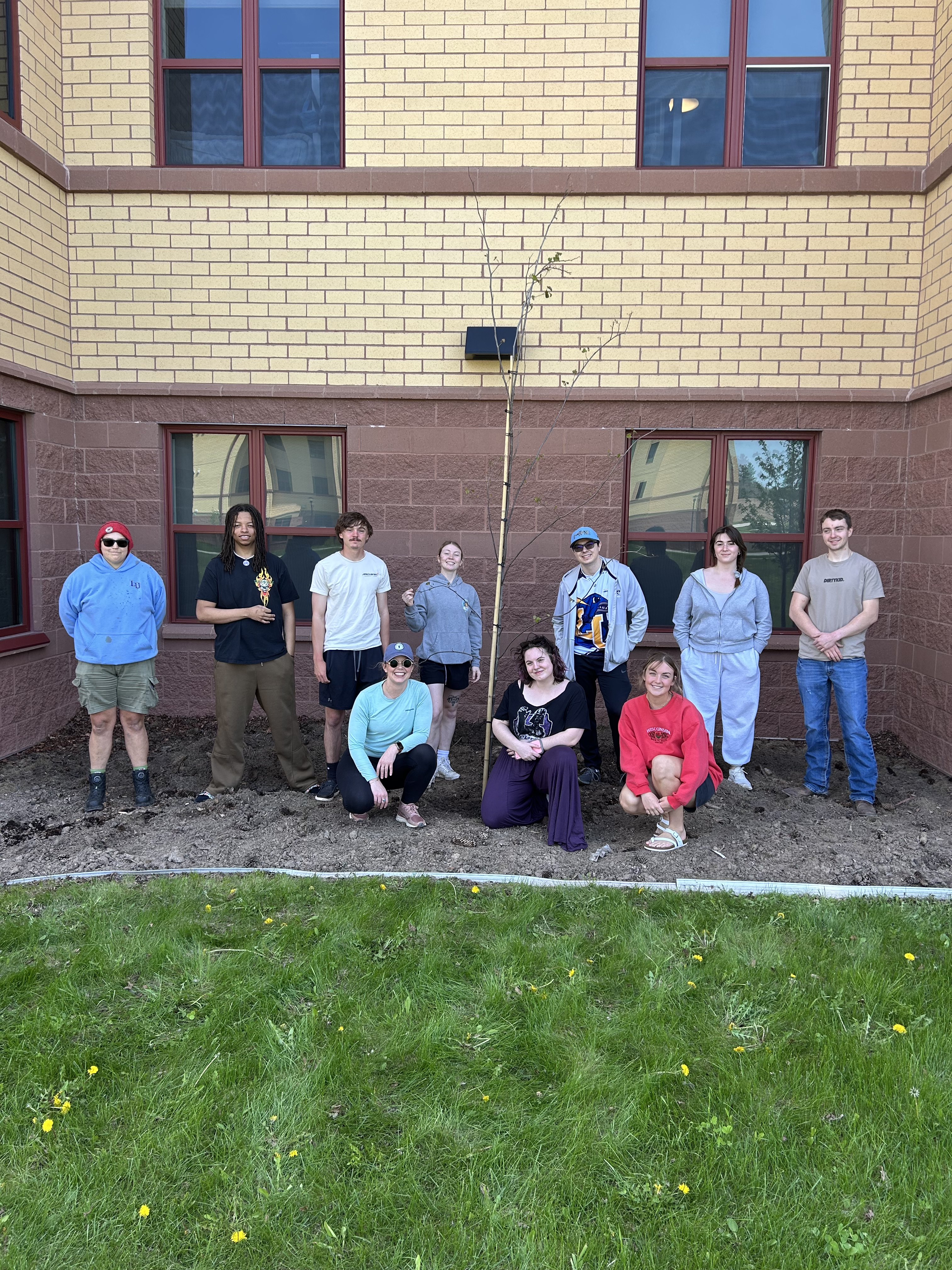
- Mortag’s first group focused on the benefits of planting native plants to improve water quality. Other activities included public outreach at events like “Winter Green” at Mead Public Library in Sheboygan and partnering with Kendra Kellings, park director at Maywood Environmental Park, for native plant guidance.
Soloman Brandt, a student in this group, shared that “being able to not only research a topic but be able to do experiments on this topic with funding is something that we would not have been able to do otherwise. ... Seeing how people of all backgrounds ... stop and want to learn more about our research into native plants ... proved to us that we were truly engaging with the Sheboygan community. Seeing this impact we made even on a small level was rewarding.”
- Mortag’s second group investigated the impact of how invasive species affect human health and the health of the environment. This group collaborated with Jensen on invasive species at Lakeland, such as the Japanese Barberry. It also held an Invasive Species War Day for campus/community engagement and education and removed numerous Japanese Barberry bushes and honeysuckle around campus.
“Our main focus was on how to combat invasive species at a local level,” said Ashton Parker, a student in the group. “Invasive species is an insanely huge topic, so figuring out how to shrink it to a manageable size was tough. However, we were able to create an idea that was relevant and small enough to manage.”
Jensen spent more time working with this group since invasive species are a personal interest. “We talked about the invasive species that are on campus, the impact that invasive species have on campus, and the most effective ways to combat invasive species on campus,” he said. “The team was well organized and enthusiastic. They had some great ideas and worked hard to get buy-in from the students, faculty and staff.”
Mortag said a major takeaway for students was a shift from the traditional product/output focus to a focus on building relationships, creating conversations and inviting multiple viewpoints to educate and drive change.
“I think that's such a value to them in regard to learning to collaborate and bring people together, which is not an easy thing to do,” Mortag said.
The classes put Lakeland’s experiential learning approach on full display through numerous takeaways for students including:
- Gaining hands-on experience with complex, real-world problem solving and community partnerships.
- Practicing project management, budgeting and iterative experimentation resulting in enhanced communication, collaboration, active listening and relationship-building skills.
- Increasing resilience and recognition that failure and adaptation are part of effective problem-solving.
- Acquiring a reduced sense of environmental hopelessness and instead, a realization that change is possible and that diverse, passionate community members exist.
- Understanding that awareness of misinformation and disinformation is important to understand the impact on environmental issues.
- Increasing the number of broader conversation and engagement surrounding divisive environmental topics and enhancing unity across different values and backgrounds around shared challenges.
Both instructors were a natural fit to lead these courses as they demonstrate expertise and passion for environmental and consumption in their everyday lives.
Piper, who successfully secured a grant to fund the classes, has had a long-standing passion for the environment, rooted in personal history and academic work on American nature writing and Indigenous environmental beliefs.
Mortag upholds personal motivations and a family commitment to reduced consumption and zero waste, making experiential learning a central goal for both.
Piper said she hopes students took away, “how to work with each other, how to work with community partners, how to respect different viewpoints and come to a consensus. But also, how prevalent misinformation is and how we're affected by it every day in our lives. And also, how difficult it is to come together and try to solve these really complex problems in a way that accounts for different opinions and different stakeholders."
Mortag she hopes that students took away the idea that, "discussing global warming can be very doom and gloom because the fight against it seems hopeless. My hope is that through this WiLead project, my students hear voices from within their community that do share their value in protecting and nurturing our environment."
From the student perspective, Parker said he came to understand that people do value the views of college students. “This experience helped me and my group learn how to get our voices heard in the greater community,” Parker sad. “The skills that we learned from the experience are valuable for our careers.”
Jensen said all groups produced positive results. “I saw energy and enthusiasm, and some very smart and talented students doing their best to affect change with the time and resources they had,” he said.
Going forward, there are hopes to continue the work of these groups, some of which will be sustained by Lakeland’s new, burgeoning environmental student group, Environmentally Lakeland.