Blog
Lakeland science students enjoy living laboratory in Belize
Jun. 22, 2026
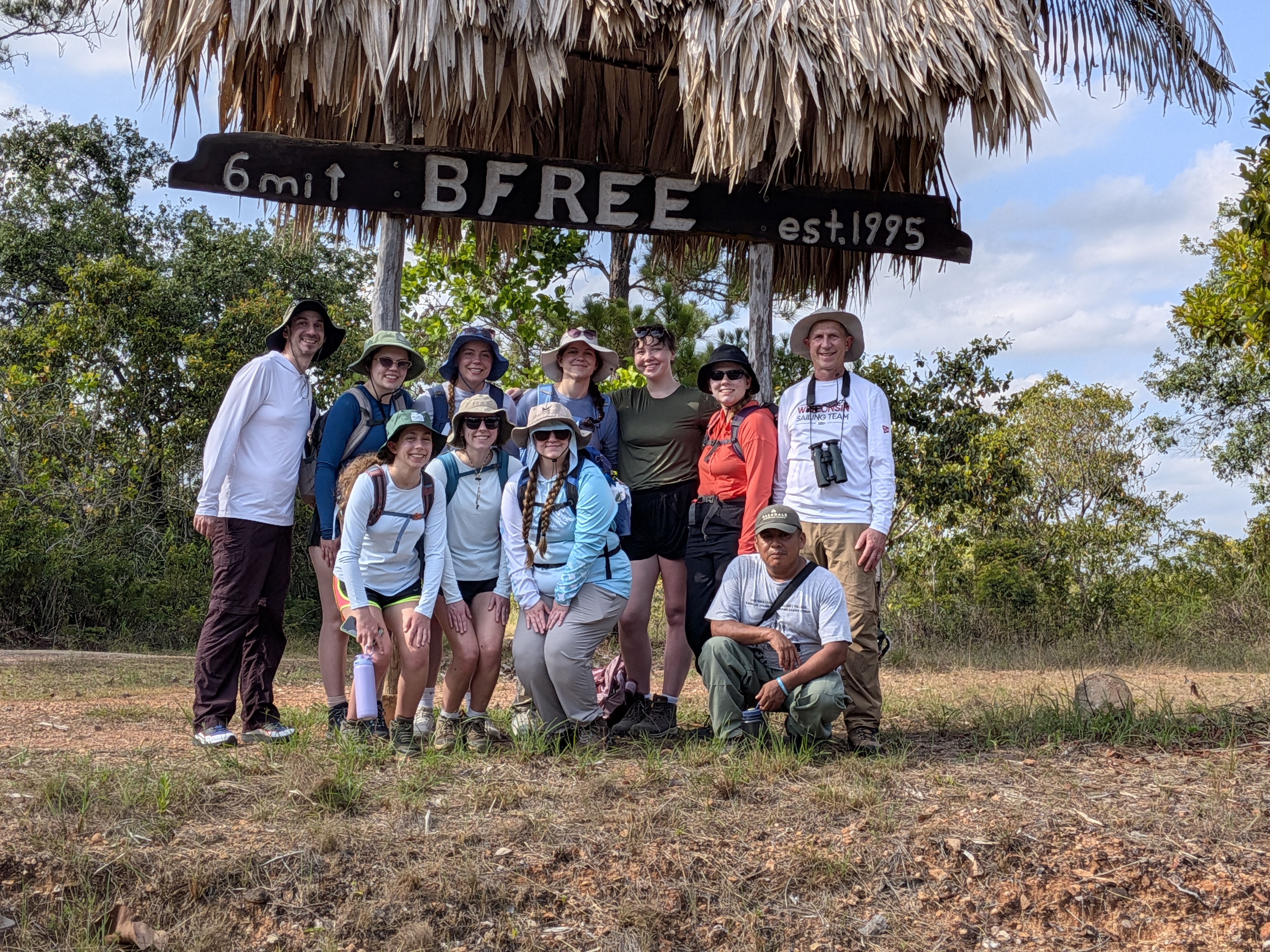
Eight Lakeland University biology and chemistry students and two faculty recently returned from a unique study abroad course that saw them conduct research in the rainforest of Belize.
It is the ninth time that Lakeland has offered Tropical Ecology in Belize, which was created in 2008 by biology professors Paul Pickhardt and Greg Smith. Pickhardt led this trip with Associate Professor of Biology Andrew Karls.
Students on the trip included Gretchen Augustine, Serena Brunner, Olivia Heling, Mary Johnson, Hollee Kaiser, Emily Landolf, Meghan MacPhee and Eva Salm.
Belize is a tiny country, about the size of New Hampshire or Vermont, east of Guatemala on the eastern coast of Central America.
The centerpiece of the 15-day trip is nine days and eight nights at the Belize Foundation for Research & Environmental Education (BFREE), a private, protected area of 1,153 acres which adjoins what is considered the largest, contiguous tract of rainforest north of the Amazon.
It’s a hotspot for biodiversity where tapirs, howler monkeys, jaguars and various parrot species are often spotted, and is the last stronghold for many endangered species, including the rare harpy eagle.
BFREE, a nonprofit founded in 1995, strives to successfully integrate scientific research, environmental education, conservation and create sustainable development opportunities for alternative livelihoods for Belizeans.
Pickhardt noted that the course occurs during Belize’s driest month and temperatures during the day typically soar into the high 90-degree range with high humidity. Despite the high temperatures and humidity, the 10 course participants hiked six miles into and out of the BFREE property.
After spending part of the first day in the world’s first jaguar preserve, the group walked to BFREE in 95-degree heat to reach the lowland tropical rainforest where they would conduct their research. The Tropical Ecology course also included a night in a Mayan village, three days of snorkeling/coral reef explorations while staying on South Water Caye 15 miles off of the coast, and a nocturnal tour of Belize’s national zoo.
While still housing myriad fish and invertebrate species, Pickhardt said that Belize’s barrier reef has degraded dramatically over the 18 years that Lakeland has offered the course due to climate change. The coral reefs of the world are all in serious decline, he said.
What follows is an overview of the research conducted by the students:
“Assessing Habitat Selection and Recolonization of Native Freshwater Snail Species in a Tropical River System” researched by Gretchen Augustine and Olvia Heling. This research pair assessed habitat selection of three species of grazing snails in the Bladen River that flows between BFREE adjacent protected areas.
Augustine, from Kiel, Wis., will be a senior in biology. She is building an impressive research resume having participated in Lakeland’s Undergraduate Research Experience (LURE) in Pickhardt’s lab in the summer of 2025. She is currently conducting biological research through Texas A & M at their Corpus Cristi, Tex., campus.
Heling, from West Bend, Wis. graduated with her bachelor of science in biology in May and she was named LU’s Outstanding Student in Biology. She will begin the pursuit of her Ph.D. in neuroscience through the Medical College of Wisconsin in August.
“An Analysis of Host Plant Occurrence of Bromeliads and Philodendrons in a Lowland Tropical Rainforest Swamp” researched by Serena Brunner, Mary Johnson and Emily Landolf. These students assessed if epiphytic plants (plants living on other plants) demonstrated higher occurrence on specific trees within a rainforest swamp on the BFREE property.
Brunner, from Glenbeulah, Wis., graduated in May with a double major in biology and chemistry and biochemistry. She hopes to work as research technician prior to considering graduate school.
Johnson, from Sheboygan, Wis., graduated in May with a bachelor’s degree in biology and chemistry and biochemistry. She is going into nursing and she begins the masters in nursing program at Marquette University in August.
Landolf, from Corning, N.Y., graduated in May with a bachelor’s in biology. She begins her graduate program in forensic science at Cedar Crest College in Allentown, Pa., later this summer.
“Herbivory of Theobroma cacao in an Agroforestry Environment” researched by Hollee Kaiser, Meghan MacPhee and Eva Salm. The group researched the herbivory differences noted on cacao trees found within BFREE’s agroforestry system and the wild heirloom cacao trees found within the intact lowland rainforest.
Kaiser, from Plymouth, Wis., is a biology and chemistry and biochemistry major entering her junior year. She is currently conducting LURE research with Karls. Post graduation, Kaiser hopes to pursue a career in veterinary medicine.
MacPhee, from Marquette, Mich., is entering her senior year as a biology and exercise science major. She conducted LURE research in Karls’ lab in 2025 and this summer she is doing research with Pickhardt. After graduation, MacPhee plans to attend medical school after taking a gap year to work in healthcare.
Salm, from Valders, Wis., is entering her junior year as a biology and chemistry and biochemistry major. She is currently conducting LURE research with Lakeland Assistant Professor of Chemistry and Food Safety & Quality Leili Afsah-Hejri. Salm plans to pursue doctoral studies in microbiology after graduating from Lakeland.
The Belize tropical ecology course will next be offered in May of 2028.