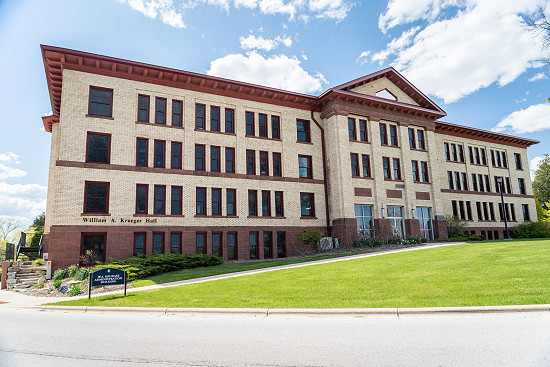
This page is here to give students easy access to the tools and tips needed to land a job. You’ll find resources on writing resumes and cover letters, preparing for interviews, sending thank-you notes, following up with employers, and other small actions that can make a big difference in your job search. Everything is designed to help you feel confident, prepared, and ready to take the next step in your career.
Job Searching
Places to start looking and things to watch out for.
While job searching, it’s important to be aware of potential scams. It can sometimes be difficult to tell the difference between real opportunities and fake job postings, as scammers may try to steal your personal information.
Warning signs a job opportunity is a scam:
References
Indeed Editorial Team. (2025, October 2). How To Identify Fake Job Postings: 10 Warning Signs. Indeed. https://www.indeed.com/career-advice/finding-a-job/how-to-know-if-a-job-is-a-scam
Resumes Writing and Following Up After Applying
How to structure a resume, what it should include, and how to follow up with an employer after applying.
A resume is a summary of your work history, skills, and education. It should be tailored to be relevant to the job you are applying for.
Category |
Action Verbs |
|
Leadership & Management |
Led, Supervised, Directed, Coordinated, Organized, Oversaw, Managed, Delegated, Executed, Mentored, Guided |
|
Teamwork & Collaboration |
Collaborated, Supported, Partnered, Contributed, Assisted, Participated, Unified, Cooperated, Facilitated |
|
Communication |
Presented, Explained, Informed, Wrote, Composed, Edited, Corresponded, Negotiated, Persuaded, Advised |
|
Problem-Solving & Critical Thinking |
Analyzed, Evaluated, Resolved, Diagnosed, Investigated, Improved, Optimized, Streamlined, Identified, Tested |
|
Technical & Analytical Skills |
Programmed, Designed, Developed, Engineered, Installed, Configured, Implemented, Operated, Troubleshot |
|
Creative & Innovative Skills |
Created, Designed, Developed, Conceptualized, Initiated, Launched, Produced, Enhanced, Modernized |
|
Organization & Efficiency |
Planned, Scheduled, Prioritized, Organized, Coordinated, Documented, Processed, Systematized |
|
Customer Service |
Assisted, Supported, Responded, Resolved, Advised, Instructed, Ensured, Handled, Delivered |
|
Teaching & Training |
Trained, Educated, Instructed, Coached, Demonstrated, Guided, Facilitated, Tutored |
|
Achievement & Results |
Achieved, Exceeded, Increased, Reduced, Improved, Completed, Delivered, Expanded, Strengthened |
If you haven’t heard back within one to two weeks, reach out directly to the recruiter or hiring manager. Let them know you’ve applied, and keep your email short and polite.
Template:
Subject line: Follow-Up on [Internship or Position Title] Application
Dear [Hiring Manager’s Name],
I recently applied for the [Internship or Position Title] at [Company Name] and wanted to follow up to see if there’s an update on the hiring timeline.
I’m very enthusiastic about the opportunity to contribute to [Company Name] and to apply the skills I’ve developed through my coursework and experiences in [relevant area, e.g., IT, marketing, sports management, etc.].
I’ve attached my application materials again for your convenience and would be happy to provide any additional information. Thank you for your time and consideration and I look forward to hearing from you.
(Attach your resume and cover letter if you used one to apply.)
Best regards,
[Your Name]
[Your Phone Number]
[Your Email Address]
Download: Follow up after applying email template
References
Birt, J. (2025, June 9). How long should you wait to hear back about a job? Indeed. https://www.indeed.com/career-advice/finding-a-job/how-long-should-you-wait-to-hear-back-about-a-job
Glassdoor. (n.d.). How to write a resume. Glassdoor. https://www.glassdoor.com/blog/guide/how-to-write-a-resume/
Keiling, H. (2025, June 8). How to list education on a resume (with examples). Indeed. https://www.indeed.com/career-advice/resumes-cover-letters/how-to-list-education-on-a-resume
Resume Examples
Resume guide and student examples.
Resume guide/template:
A step-by-step resource that explains how to structure a resume, what information to include, and how to format each section. This guide provides students with a clear starting point and helps to avoid common resume mistakes.
Student Examples:
Realistic sample resumes that demonstrate how different students might present their experiences. This includes skills, education, work experiences, volunteering, clubs, sports, and more.
Cover Letters
What a cover letter is and what it should include.
A cover letter introduces you to employers, highlighting relevant coursework, projects, and ambition. It shows your communication skills and attention to detail, helping you stand out even without much work experience.
You should include a cover letter whenever an application requests one, even if it is listed as optional. If the application specifically states that a cover letter is not required, then it should not be submitted.
A cover letter should briefly introduce you, highlight your strengths, and showcase experiences relevant to the job, especially those not fully detailed on your resume. You can also use it to go more in-depth about a specific experience and explain why you’re a strong fit for the position. It could include:
Template:
[Your Name]
[Your Phone Number]
[Your Email Address]
[Optional: Your Mailing Address]
[Date]
Dear [Hiring Manager’s Name or Title],
(If you do not know their name, you may use “Dear Hiring Manager,”)
[Introduce yourself and state the position you are applying for. Briefly explain why you’re interested in the role and mention at least one key reason you would be a strong fit.]
[In the first body paragraph, describe a recent accomplishment or experience that demonstrates relevant skills. Explain how your contribution made an impact and how those skills will help you succeed in this role.]
[In the second body paragraph, highlight special skills, experiences, or motivations that make you stand out. You can discuss how you developed your passion for the field and how this opportunity aligns with your career goals.]
[In the third body paragraph, explain why this company or organization appeals to you. Mention specific values, projects, or goals that align with your interests.]
[Conclude by expressing enthusiasm for the position and stating that you look forward to discussing your application further.]
Sincerely,
[Your Name]
Download: Cover Letter Template
References
Indeed Editorial Team. (2025, June 9). Student cover letters with template and example. Indeed. https://www.indeed.com/career--advice/resumes-cover-letters/cover-letter-of-student
Interviewing
Interviewing etiquette and example questions.
1. Dress & First Impressions
2. Before the Interview
3. On the Day of the Interview
Many first round interviews are conducted virtually so it is beneficial to understand proper etiquette.
Question |
Example Answer - Using STAR method (Situation-Task-Action-Result) when applicable |
|
Tell me about yourself. |
"I am a student currently studying [field] and have completed coursework and projects that have given me experience in [relevant skills]. I enjoy applying what I’ve learned in practical situations and am excited to contribute to this role." |
|
Why are you interested in this role/company? |
"I am interested in this role because it aligns with my skills and the career path I am pursuing. I admire the company’s focus on [specific value or goal], and I am eager to contribute and learn from this team." |
|
Describe a time when you faced a challenge. What did you do? |
(S) In a group project, our team fell behind schedule. (T) I needed to help get us back on track. (A) I organized extra meetings, coordinated tasks, and suggested solutions for sticking points. (R) We completed the project on time and received positive feedback from our instructor. |
|
What are your greatest strengths? |
"I am good at problem-solving and collaborating with others. For example, during a lab project, I helped the team troubleshoot technical issues, which allowed us to finish our project successfully." |
|
What are your areas for improvement? |
"I sometimes take on too much at once, but I have been improving by prioritizing tasks and creating schedules to ensure I meet deadlines." |
|
Describe a time you worked successfully in a team. |
(S) During a class project, our team had to design a presentation together. (T) My role was to research and compile data. (A) I communicated regularly with teammates and incorporated everyone’s ideas. (R) Our presentation was well-received, and we got an excellent grade. |
|
Tell me about a time you demonstrated leadership. |
(S) I was elected team leader for a project. (T) I needed to ensure all team members stayed on task. (A) I delegated responsibilities, held check-ins, and encouraged participation. (R) Our team completed the project ahead of schedule and performed well in the competition. |
|
How do you handle tight deadlines or pressure? |
"I prioritize tasks, break them into manageable steps, and stay focused. For example, during finals week, I managed multiple assignments by creating a schedule and completing tasks efficiently." |
|
Give an example of a time you had to learn something quickly. |
(S) I had to use a new software tool for a class project. (T) I needed to complete the project on time. (A) I studied tutorials, practiced using the software, and asked questions when needed. (R) I successfully used the software to complete the project. |
|
Why should we hire you? |
"I have the skills and motivation to contribute to this role. I am eager to learn and apply my academic experiences in a real-world setting." |
|
Tell me about a time you made a mistake. How did you handle it? |
(S) I accidentally submitted incomplete work for a group project. (T) I needed to correct it quickly. (A) I notified my team, corrected the work, and reviewed everything carefully. (R) The project was completed successfully, and we learned to double-check our work. |
|
Describe a project you are most proud of. |
(S) I worked on a class project to develop a small app. (T) I was responsible for part of the coding and testing. (A) I collaborated with my teammates and solved technical problems as they came up. (R) The app worked as intended, and our team received a top grade. |
|
How do you prioritize tasks when you have multiple deadlines? |
"I make a list of all tasks, determine which are most urgent, and create a schedule to ensure everything is completed on time." |
|
Tell me about a time you disagreed with someone. How did you resolve it? |
(S) A teammate and I disagreed on how to approach a project. (T) We needed to find a solution that worked for both of us. (A) I listened to their perspective, suggested compromises, and we tried both ideas. (R) We completed the project successfully and both felt our ideas were valued. |
References
Indeed Editorial Team. (2025, May 3). How to make a great impression in a job interview. Indeed Career Advice. https://www.indeed.com/career-advice/interviewing/job-interview-tips-how-to-make-a-great-impression
U.S. Department of Labor. (2024, January). Interview tips. https://www.dol.gov/general/jobs/interview-tips
After Interviewing
Post-interview thank you and follow up emails.
Thank you email template:
Subject: Thank You — [Position Title] Interview
Dear [Hiring Manager’s Name],
Thank you for taking the time to interview me on [Date] for the [Position Title] at [Company Name]. I enjoyed learning more about the role and the team, and I am enthusiastic about the opportunity to contribute.
In our discussion, I was particularly interested in [mention something specific you discussed, e.g., “the project you described around expanding the company’s data analytics”], and I believe my [mention a relevant skill or experience] can help achieve that goal.
Please let me know if you need any additional information from me. I look forward to the possibility of working together and appreciate your consideration.
Sincerely,
[Your Name]
[Your Phone Number]
Download: After interview thank you email template
Follow-up email template:
This can be used when you haven’t heard back within one to two weeks (or within the timeframe given by the employer) to politely follow up on the status of your application and reiterate your interest in the position.
Subject: Follow-Up on [Position Title] Application
Dear [Hiring Manager’s Name],
Thank you for meeting with me on [Date] for the [Position Title] at [Company Name]. I appreciated the opportunity to learn more about your team and the role, especially [mention a specific topic or highlight from the interview].
I remain very excited about the possibility of joining your team and contributing [mention a specific skill or experience you bring]. I believe this role aligns well with my goals and background, and I’m confident I can add value in [briefly indicate how you’ll contribute].
Thank you again for your time and consideration. I look forward to the possibility of the next steps.
Best regards,
[Your Name]
[Your Phone Number]
[Your Email Address]
Download: After interview follow up email template
References
Indeed Editorial Team. (2025, July 9). Follow‑up email after an interview (examples and template). Indeed Career Advice. https://www.indeed.com/career-advice/interviewing/follow-up-email-examples-after-interview
Networking and Online Profiles
Networking in-person and online
1. Profile Basics
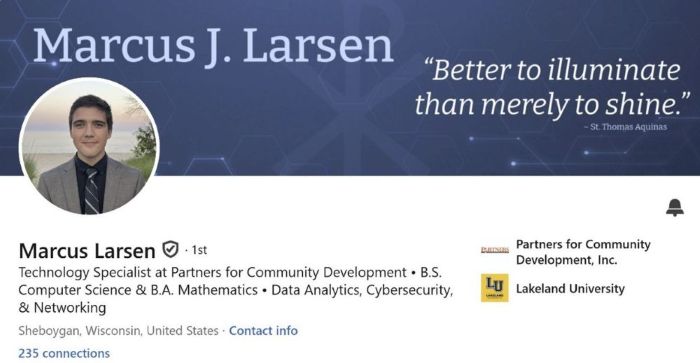
Lakeland Student Marcus Larsen’s LinkedIn Profile
2. Education
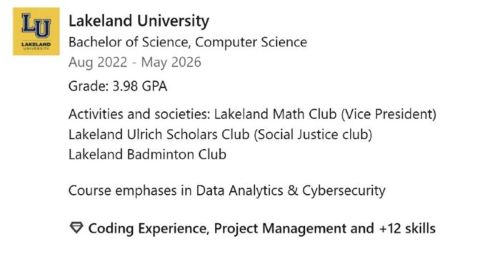
Lakeland Student Marcus Larsen’s LinkedIn Profile Education Section
3. Experiences & Skills
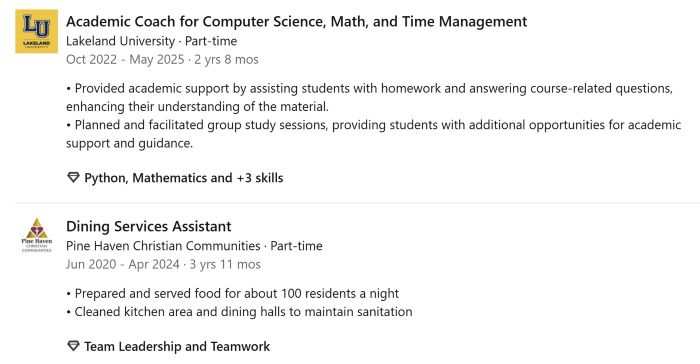
Lakeland Student Hannah Pratsch’s LinkedIn Profile Experience Section
4. Engagement & Visibility
References
Liu, J. (2023, May 22). The ultimate guide to crafting a LinkedIn profile that recruiters love: Advice from 100 hiring professionals. Forbes. https://www.forbes.com/sites/josephliu/2023/05/22/the-ultimate-guide-to-crafting-a-linkedin-profile-that-recruiters-love-advice-from-100-hiring-professionals/
The Muse Editors. (2024, November 19). How to Network in College (And Why It Matters). The Muse. https://www.themuse.com/advice/network-in-college
CVs
What a CV is and how to structure it.
A curriculum vitae (CV) is a detailed overview of your academic and professional experiences. Unlike a resume, which is usually 1–2 pages, a CV can be longer and is commonly used for academic, research, or scholarship applications. Students, recent graduates, or anyone applying for internships, research programs, or academic positions should use a CV to highlight education, projects, skills, and accomplishments in a structured, professional way.
Use a clean layout and simple fonts. Be consistent with formatting and update your CV regularly as you gain new experiences.
Resources
Purdue Online Writing Lab. (n.d.). Writing the curriculum vitae. Purdue University. https://owl.purdue.edu/owl/job_search_writing/resumes_and_vitas/writing_the_cv.html
Templates
Resumes, cover letters, thank you emails, and follow up emails.
Resume guide/template:
This provides a structured format and example for creating a professional résumé. It helps students organize their education, work experience, skills, and accomplishments in a way that is clear, concise, and appealing to employers.
Cover letter template:
This gives a guide for writing a cover letter. It helps students explain why they are a strong candidate for a position, how their skills match the job, and why they are interested in the company.
Follow up after applying email template:
This template is for sending a professional email after submitting a job or internship application. It politely expresses continued interest in the position and can help reinforce your candidacy.
Thank you for the interview email template:
This provides a structure for sending a thank-you email after an interview. It allows candidates to express gratitude for the opportunity, reinforce interest in the role, and briefly highlight qualifications.
Follow up after interviewing email template:
This template is for sending a follow-up email if you haven’t heard back after an interview. It shows professionalism, maintains communication, and demonstrates continued interest in the position.
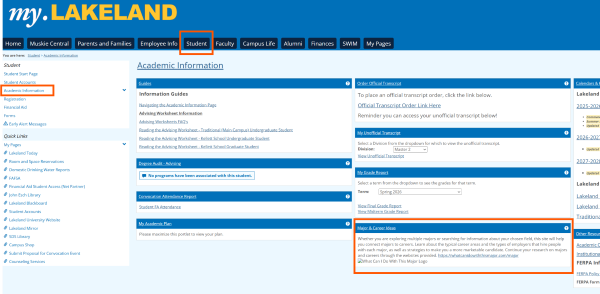
What Can I Do With My Major?
Whether you are exploring multiple majors or searching for information about your chosen field, this site will help you connect majors to careers. Learn about the typical career areas and the types of employers that hire people with each major, as well as strategies to make you a more marketable candidate. Continue your research on majors and careers through the websites provided.
Learn more at my.Lakeland under the student > academic information tab.
MCode Career Personality Test
MCode isn’t just another personality test. It’s a research-backed, story-driven framework grounded in over 60 years of behavioral science, built to uncover the core motivations that shape how students think, work, connect, and grow. It empowers you—as an educator, advisor, or mentor—to move beyond surface-level conversations and guide students using what truly energizes them.
It’s the difference between a one-size-fits-all program and a personalized approach that leads to deeper engagement, better decisions, and lasting transformation in every area of the college journey.
MCode is the first and only narrative-based assessment that helps people understand their innate motivational patterns by revisiting their personal achievement stories — activities and moments in their lives where they felt the most joy, success, and personal satisfaction.